I am a Postdoctoral Research Fellow at the Department of Information Engineering (University of Pisa) with a hybrid profile bridging experimental Psychology with Biomedical Engineering.

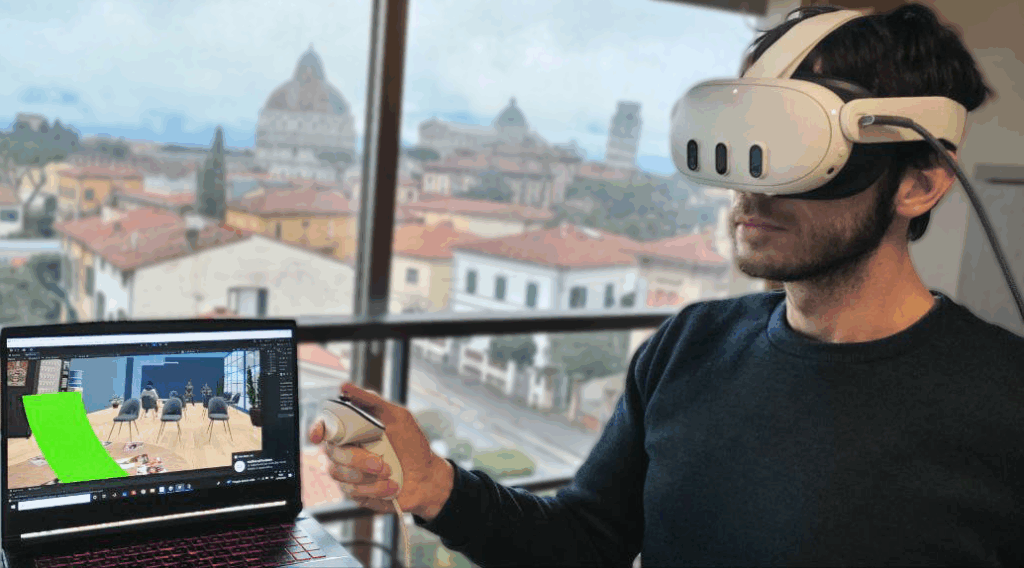
My research focuses on the intersection of immersive technologies (VR/AR) and Psychophysiology. I specialize in designing virtual environments adapting in real-time based on the psychophysiological correlates recorded by integrated wearable biosensors (EEG, ECG, EDA) to assess and treat anxiety disorders.

The study of brain correlates of consciousness and of subliminal stimuli in psychopathologies (arachnophobia and PTSD, in particular) fostered my interest in the characterization of thresholds (both perceptual and emotional ones), which is central to the current scientific debate on the nature of emotions.

I’ve authored enough systematic reviews and meta-analyses to appreciate and fully embrace the principles of open science: all my research comes with data, codes, multimedia. All the tools developed are meant to be used by other clinician &/or scientists: all the data I collected are meant to be analyzed with new approaches by other researchers.

Research areas

My main current interests concern the nature of emotions in their healthy and psychopathological examples. In particular, I’m contributing to develop:

  • tools to exhaustively characterize the most relevant and shared symptom in all the anxiety disorders I studied, i.e., avoidance;
  • virtual scenarios adapting in real time to the anxiety level of patients to maximize both therapeutic efficacy and exposure tolerability

Background

While attending the University in Bologna I worked as a graphic designer (building website like the one you are looking at right now), and after graduating I accepted a life-long contract in a wonderful company. I gave up after three years to follow my research dream at the University of Pisa.

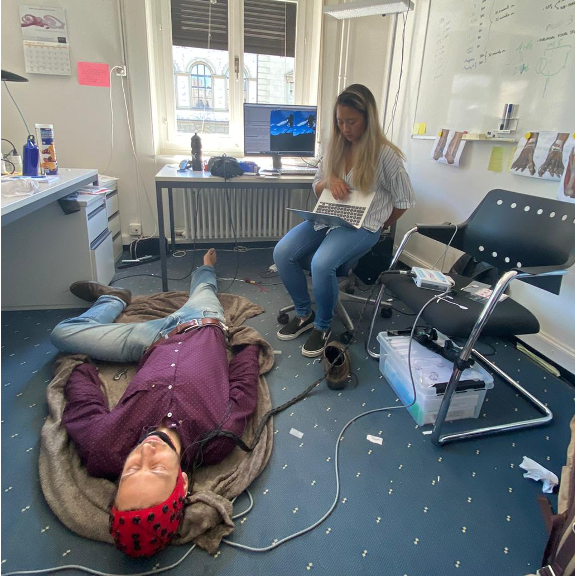
Here, I had the opportunity to conduct psychophysiological experiments about consciousness and emotions on sample of people with specific phobia, PTSD, and social anxiety disorder. Perceptually- and emotionally-subliminal stimuli dominated my focus during the PhD.

Plans for the future

My main ambition is to develop tools, theories and paradigms that can have a real impact in the everyday-life of people: I hate the idea of spending years of work for something that is kept on some (virtual) shelf.

To reach this goal, I’m applying to the appropriate funding calls, and I’m open to national and international collaborations – which is one of the main reasons to show off what I can do on this website. Feel free to contact me in case my skills align with the project you are writing!

Invited talks

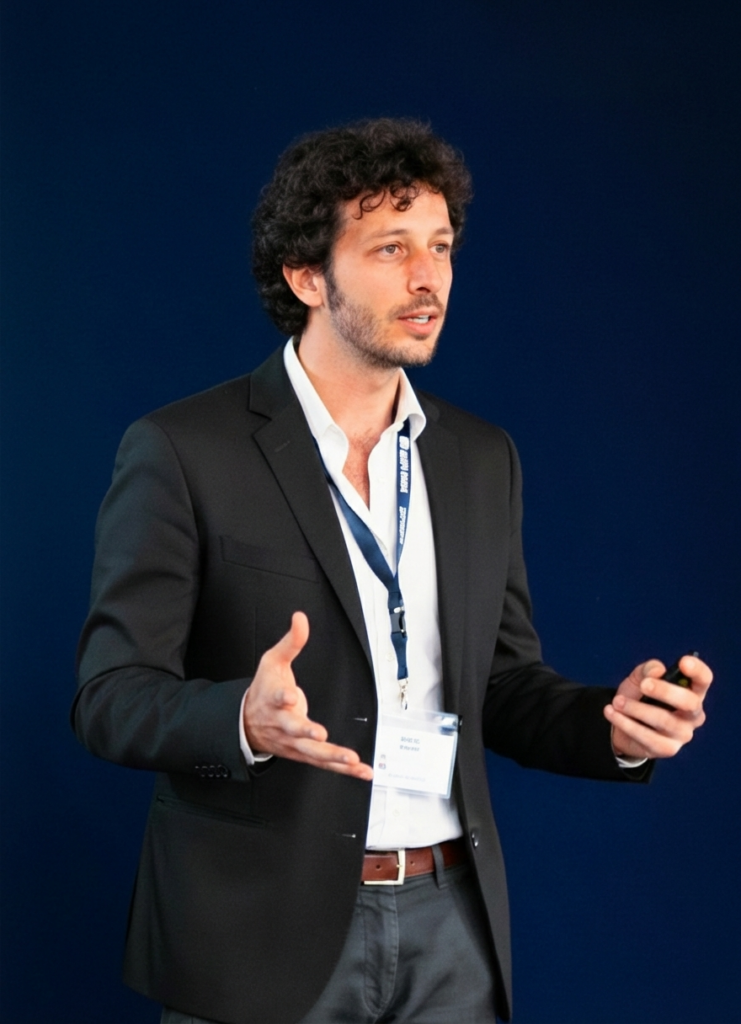
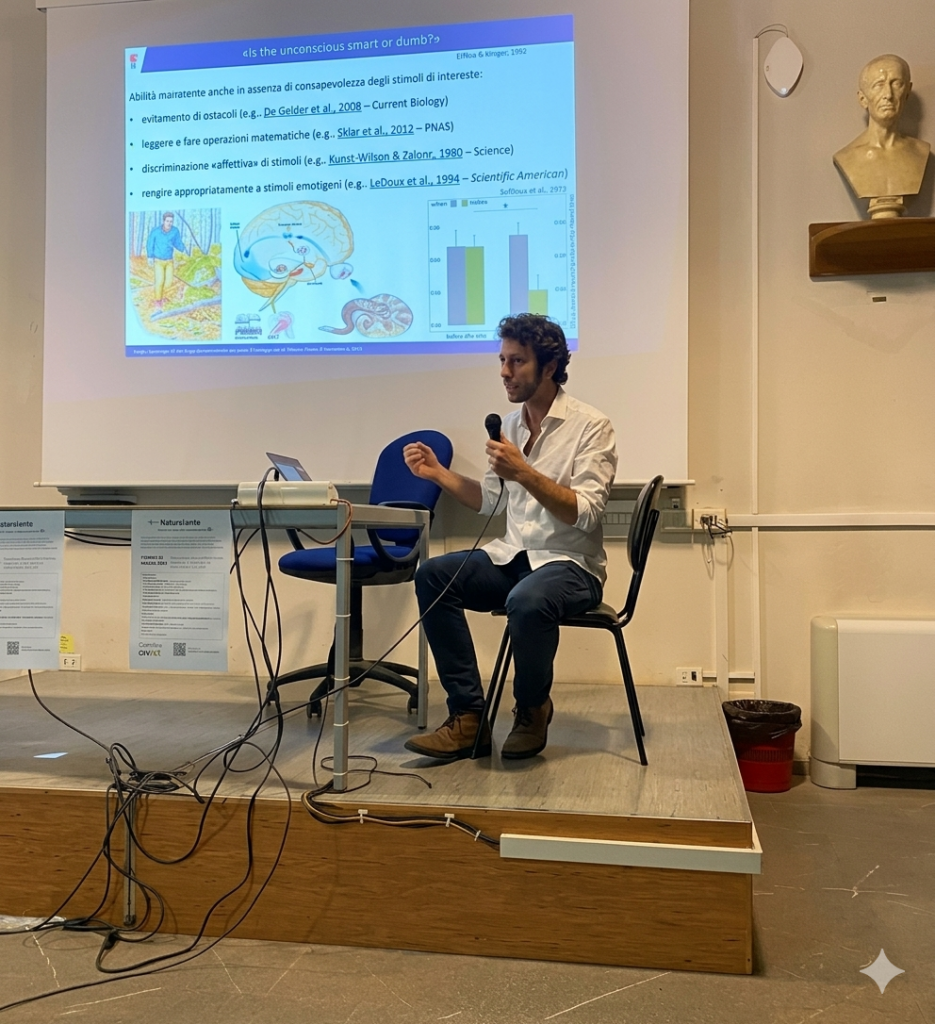
As you can see, I enjoy invited talks! Invite me through the Contacts section of this page

  • Invited Lecture at the Neuroengineering Lab (Prof. Staniša Raspopović), Medical University of Vienna (6 October 2025) – Topic: Integration of VR with physiological signals for the development of adaptive therapeutic scenarios

  • Invited speaker at the Psychology Department of the University of Turin after invitation by Prof. Marco Tamietto, Prof. Francesca Garbarini, Dr. Matteo Diano, January 13th, 2023 – Topic: Unconscious multimodal integration: behavioral and neural evidence from subliminal stimuli administered in Virtual reality

  • Invited speaker at the Ukrainian congresses (carried out online for conflict-related reasons) on Clinical Environmental Medicine (April 25th, 2025) and Preventive Medicine (October 16th, 2023), upon invitation of Prof. Olena Hryhoryan from the University of Kharkiv to present the results of a joint project – Topic (2025): Sleep burden and emotional resilience among Ukrainian war refugees with or without PTSD: a PsyToolkit survey – Topic (2023): Behavioral correlates and therapeutic potentials of subliminal stimulation in Augmented Reality for war-related PTSD

  • Invited speaker at the international congress “The Science of Consciousness Conference” in Taormina (Italy), May 2023, with a 20-minutes oral presentation – Topic: Behavioral and neuroimaging evidence of subliminal multisensory integration challenge the prevailing theories of consciousness (here are openly shared the slides)

    I’m not in this picture, as I’m taking it: it depicts Anil Seth humbly queueing to pose a question to Chalmers

International network

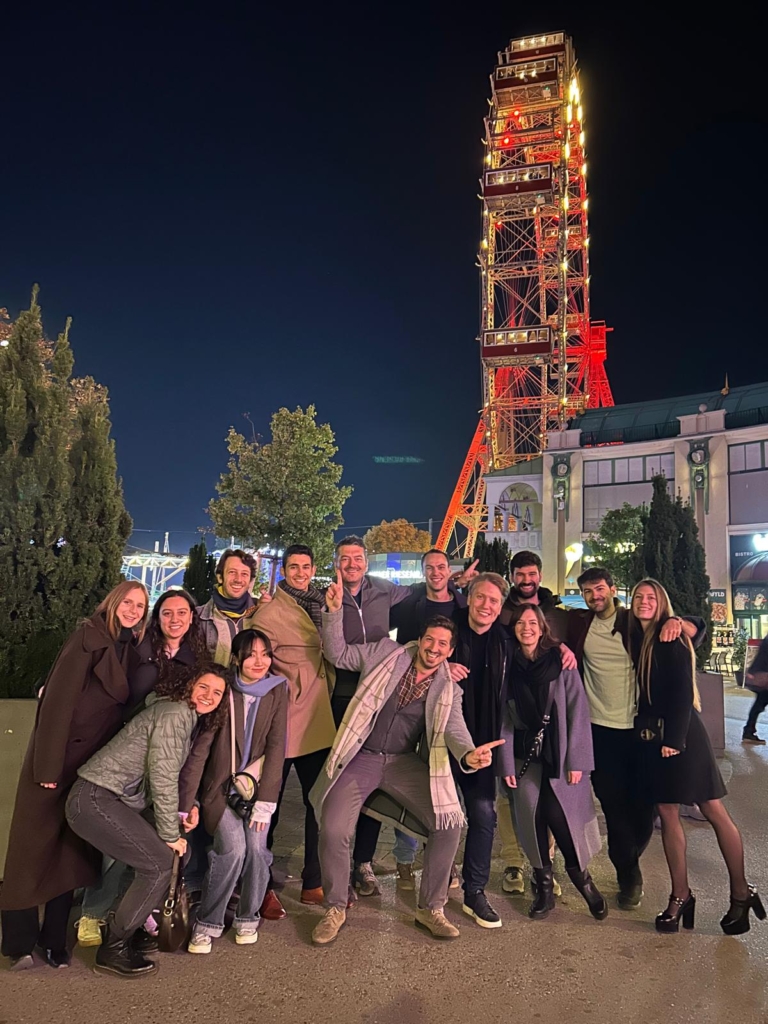
I was lucky enough to meet many interesting researchers during my path. Here are some of them:

  • Prof. Frank Scharnowski (Austria) – a visiting period to his lab at UniWien was recently selected for a grant in the Post-doc Mobility call by the Circle U. alliance of Universities
  • Prof. Staniša Raspopović (Austria) – we collaborate since my PhD, when he was my visiting tutor: his scientific integrity was inspirational to me. We would like to keep on collaborating thank to some dedicate funding
  • Prof. Olena Hryhoryan (Ukraine) – we collaborate since 2022 on research studies about war PTSD which are unfortunately more and more timely, while applying for fundings to continue our experiments
  • Dr. Marina Baroni (Germany) – we co-authored systematic reviews and meta-analyses on subliminal stimulations in Panic Disorder and in PTSD (with our former colleague Valentina Cesari and many others)
  • Prof. Simone Grassini (Norway) – we co-authored a paper thanks to the common collaboration with Dr. Enrico Cipriani and Prof. Danilo Menicucci, with whom we both contribute on this award-winning Frontiers’ special issue edited by Dr. Valentina Cesari
  • Dr. Rajanikant Panda (U.S.A., Liége) and Dr. Natalija Katic (Austria) – we met through shared colleagues and we are still co-editors of this Frontiers’ special issue since 2024
  • Prof. Jicheng Chen (China) – we collaborate on a special issue since sharing comparable research interests about consciousnes

Grant writing

Every morning, an early-career researcher knows that (s)he will need to run faster than the other early-career researchers as desperate as him in pursuing a tenure position

That’s why I applied to many grants, mostly contributing to write those submitted by tutors and colleagues. I also wrote some personal ones, so far without success: the only award I could win was the University of Pisa grant for ERC (European Research Council) proposal preparation support, however my project was rejected despite this support (c’est la vie).

That’s why I’m more than open to collaborate on grant writing as PI or as a collaborator! That’s what I bring to the table:

  • proved availability of dozens of hardly-reachable patients suffering from the following mental issues:
    • specific phobias
    • PTSD
    • Social Anxiety Disorder (SAD)
  • an official license as Clinical Psychologist
  • I’m less than 40 years old, and earned my PhD in 2022 (sometimes this earns me the title of “young investigator”)
  • I’m a strange but eventually useful hybrid between an Experimental psychologist, a Psychophysiologist and a Biomedical engineer (ranked for expertise)
  • I’m an expert user of devices for the record of psychophysiological signals (e.g., EEG, EDA, ECG…), virtual/augmented reality systems (e.g., Oculus Quest, HTC Vive, Holobox…), and online questionnaire platforms (e.g., PsyToolkit)
  • other minor utilities, such as a higher-than-average ability to create methodological schemes and graphs (deriving from my years as a graphic designer), which is unexpectedly useful in grant writing

Tools Tools Stuff I’m good at

and some I admit to be bad at ’cause my only weakness is that I’m too humble

Here is a non-exhaustive lists of what I learnt in my life, organized accordingly with the three missions of Universities – teaching, research, and dissemination/social impact. I should have call them “professional skills”, but this is not meant to be a boring CV

Research stuff

I was lucky enough to be bad in the only thing at which AI will soon substitute me: coding. On the other side, an ability I had to learn was the recruiting of relatively-rare samples (e.g., arachnophobic participants, ~4% of the general population): it is not just hard to find them, but also to involve them in an experiment aimed at terrifying them (for science!).

Now I have some dozens of participants for each anxiety disorder I’m studying (specific phobias, PTSD, Social Anxiety Disorder…). Despite this ability, my papers were rejected from some impactful journals mainly for the sample size: I still have room for improvements, as in every facet of this job, and I want to keep improving more and more.

Beyond this, I consider myself scientifically honest and genuinely interested in finding robust answers to impactful questions, which translates in research integrity and the identification of timely scientific questions. I’m also a very efficient organizer of experiments, and I had to gain a higher-than-average experience in writing grants (“that’s the Italian academy, baby”).


Graduation-cap Graduation-cap Teaching stuff

I love to teach! It’s funny and I learn something new at every lesson I prepare. The first times I was very nervous, but after a while I started enjoying it so much that I’m doing it for free, though I would also enjoy being paid (once again: “that’s the Italian academy, baby”).
Anyway, I feel quite good at doing it: I do my best to give students something that they cannot find in text books or in LLMs, such as personal experiences in doing research and behind-the-scene hints to spot the dark side of the scientific literature.

At the end of each lesson I ask students for some anonymous feedbacks, which helped me to improve them over the years: now I’m able to carry on interactive debates supported by good-looking (but scientifically informative) slides. My favourite part is the reproduction of experiments during the lessons of General Psychology: my second-favourite part is the debunking of classical theories described in every book but disconfirmed by the newest replication studies.

Users Users Dissemination/social impact

I mean, doesn’t this webpage speak for itself? Not to mention the webpage I built for the BRAVE project, with an interview given to the national television!

I recently enjoyed scientific videomaking, and I’m a big fan of open science principles: all of my empirical studies come with an openly-accessible repository where everyone can find raw data and the codes I used to analyze them.

I’m more and more disgusted by the immoral amount of money that scientific journals make out of researchers’ unpaid peer-reviews, and I aim to free my papers from this vicious circle as soon as this choice will not undermine my metrics (did I already say “that’s the Italian academy, baby”?). My scientific spirit animal is Adam Mastroianni (sorry Adam for the “animal”, I know it does not sound as a compliment but it is).

Even if I hardly tolerate generalist social networks (Twitter X), I love using some of the most science-focused ones (e.g., BlueSky, ResearchGate, Mastodon’s FediScience) to disseminate my scientific data and to find interesting inspiration from other scientists.

Sergio Frumento

Characterizing the behavioral phenotypes of phobic avoidance

S Frumento, E Magnavacca, A Iannizzotto, A Gemignani, E Scilingo, ...

Avoidance is a core psychopathological symptom, yet its elective assessment remains overly simplistic. Here, we introduce a standardized Virtual Reality Behavioral Avoidance Test (vr-BAT) for a multidimensional, dynamic characterization of avoidance behavior.

2025

Interpersonal Sympathetic Coupling in Emotional Contagion: A Preliminary Study Using Directed Coherence

M De Marinis, F Bossi, A Gargano, S Frumento, A Callara, M Pardini, ... 2025 IEEE Medical Measurements & Applications (MeMeA), 1-6, 2025

Interpersonal physiological synchrony is a coded language for emotional and psychological connection, capable of revealing the implicit mechanisms of social interactions. Herein we investigated the interpersonal shared dynamics of the Autonomic Nervous System (ANS) in the context of emotional contagion, focusing on the measurement of interpersonal physiological causal coupling (from now on, IPCC) through Electrodermal...

2025

Deep Learning-Based Classification of Social Anxiety Disorder Using Continuous Self-Reported Anxiety in Virtual Reality

M Pardini, S Frumento, M Martini, G Rho, V Vatteroni, K Tharun, M Alaimo, ... 2025 IEEE Medical Measurements & Applications (MeMeA), 1-6, 2025

Social Anxiety Disorder (SAD) is a mental disorder characterized by excessive fear and avoidance of social situations. Traditional assessment methods rely on retrospective self-reports, which may not fully capture moment-to-moment variations in perceived anxiety. To address this, we designed a novel Virtual Reality (VR) scenario to simulate a real-life social situation, specifically a waiting room...

2025

Behavioral Avoidance Test in virtual reality (vr-BAT) and in-vivo (real-BAT)

S Frumento, E Magnavacca, A Iannizzotto, A Gemignani, EP Scilingo, ...

Volunteers were asked to participate in two experimental sessions separated by at least two weeks. In one session they were asked to undergo the vr-BAT, and in the other one the traditional version with a real spider (real-BAT): the order of the sessions was randomized.

2025

Cite Article

G Accogli, M Andreatta, S Arnau, S Brand, G Buodo, A Carandina, ... Journal of Psychophysiology 38 (4), 2024

Like many other journals, the Journal of Psychophysiology relies on the willingness of peers to contribute their time and energy to the reviewing process. We all know that reviewing manuscripts is time consuming, and that sometimes different journal editors request review of their incoming papers at the same time. The colleagues listed below have contributed...

2024

Sergio Frumento

Ph.D., licensed clinical psychologist (membership card of the Order of Psychologists number 11118)
Mastodon profile (like Twitter, but not evil)
Twitter profile (hateful but useful)
BlueSky profile (anyone there?)
ResearchGate profile
LinkedIn profile
Scholar profile
Scopus profile
OrcID profile
Loop profile
Editor of this and co-editor of this Frontiers’ special issue

I will reply as soon as possible

Contact me

Feel free to reach us for any need – whenever you want to (freely!) use the tools we developed, or you want me to share with you our data, or whatsoever

© Copyright - BRAVE Project