

The BRAVE project is a PRIN (Progetto di Rilevante Interesse Nazionale) funded by the Italian Ministry for University and Research
BRAVE Project
  • Menu Menu
  • The BRAVE project
  • Research fields
  • Latest papers
  • Media
  • Contacts

BRAVE Lab’s PI, Alberto Greco

The activities of BRAVE Lab follow a coherent scientific and technological pathway.

We begin with the design of innovative experimental protocols, move to the acquisition and modelling of physiological signals, use these signals to infer emotional states, extend the analysis to interpersonal physiological coupling, and ultimately translate these models into adaptive systems and biofeedback technologies.

This integrated approach allows us not only to measure and understand human affective dynamics, but also to design systems that can positively influence social interaction, emotional regulation, and well-being.

Research question

Understanding and recognising human emotion objectively and continuously remains one of the major challenges. Despite advances in psychophysiology and artificial intelligence, we still lack reliable tools to measure how internal emotional states unfold over time and shape human experience.

BRAVE Lab’s activity

At BRAVE Lab, we study emotion as a measurable physiological process. By combining wearable sensing, computational modelling, and adaptive technologies, we develop systems capable of estimating, reproducing, and modulating internal states directly from biosignals.

What we are building

Building on this foundation, we extend our research to how emotional and physiological dynamics unfold during social interaction, investigating how individuals influence each other and how this knowledge can be translated into technologies that enhance well-being and human experience.

Our research pathway is articulated through four tightly connected research areas ↓

Down-open Down-open

Physiological Signal Processing & Modelling

At BRAVE Lab, physiological signals are treated as rich, dynamic representations of the human internal state.

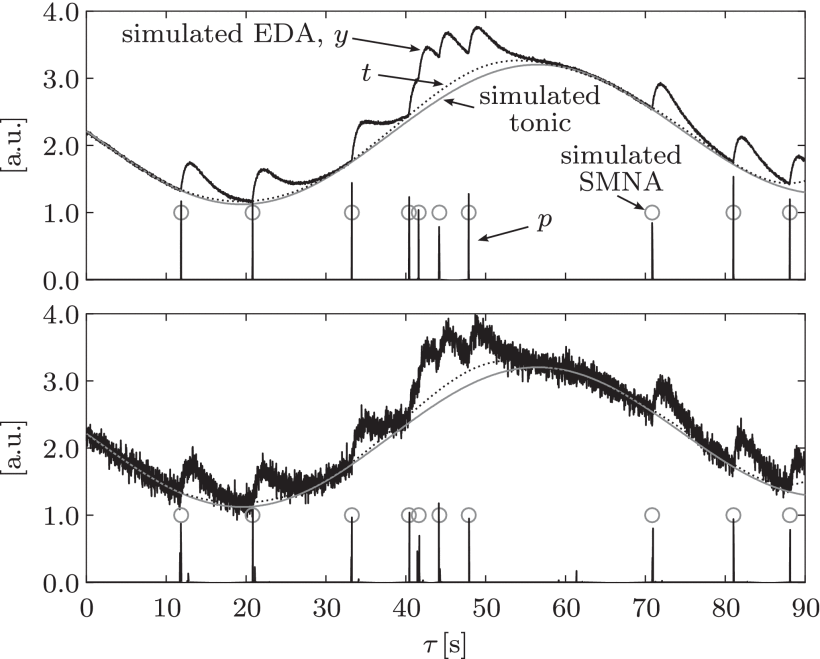
We work with multimodal recordings including ECG (from which heart rate variability is derived), EDA (electrodermal activity), respiration, and EEG, acquired through wearable and unobtrusive sensing systems. Our activity focuses on advanced preprocessing, feature extraction, and time-series modelling to transform raw biosignals into informative variables that reflect autonomic nervous system (ANS) activity. We develop statistical, machine learning, and Bayesian models capable of capturing the temporal structure and variability of physiological processes.

This foundational work enables the translation of biological dynamics into quantitative representations of latent states that can be used for emotion estimation, synchronization analysis, and real-time adaptive technologies.

Here is our most representative paper about this research line
Link Link Read it online Newspaper Newspaper Download it!

Affective Computing

BRAVE Lab develops computational AI models to infer emotional states from psychophysiological data.

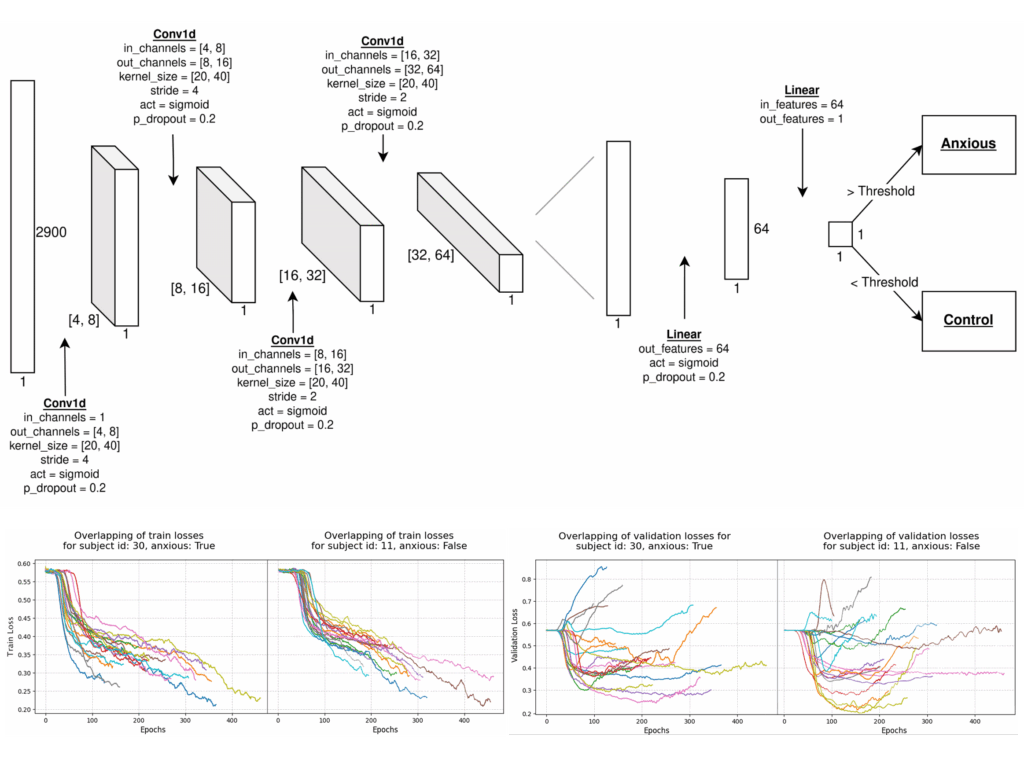
Rather than relying solely on self-report or behavioral observation, we estimate continuous dimensions such as arousal, valence, stress, and anxiety using probabilistic, machine learning, and deep learning approaches.

Our research focuses on identifying the physiological signatures that underlie emotional dynamics and on building models that can operate also in real time. This enables the reconstruction of an individual’s internal emotional trajectory during interaction or exposure to complex environments.

From our perspective, affective computing represents the bridge between physiological signals and interpretable emotional representations that can inform adaptive systems, clinical tools, and human–AI interaction.

Here is our most representative paper about this research line
Link Link Read it online Newspaper Newspaper Download it!

Adaptive Systems, Virtual Reality and Biofeedback

A central research theme at BRAVE Lab is the translation of computational models of physiology and emotion into adaptive technologies that interact with users in real time.

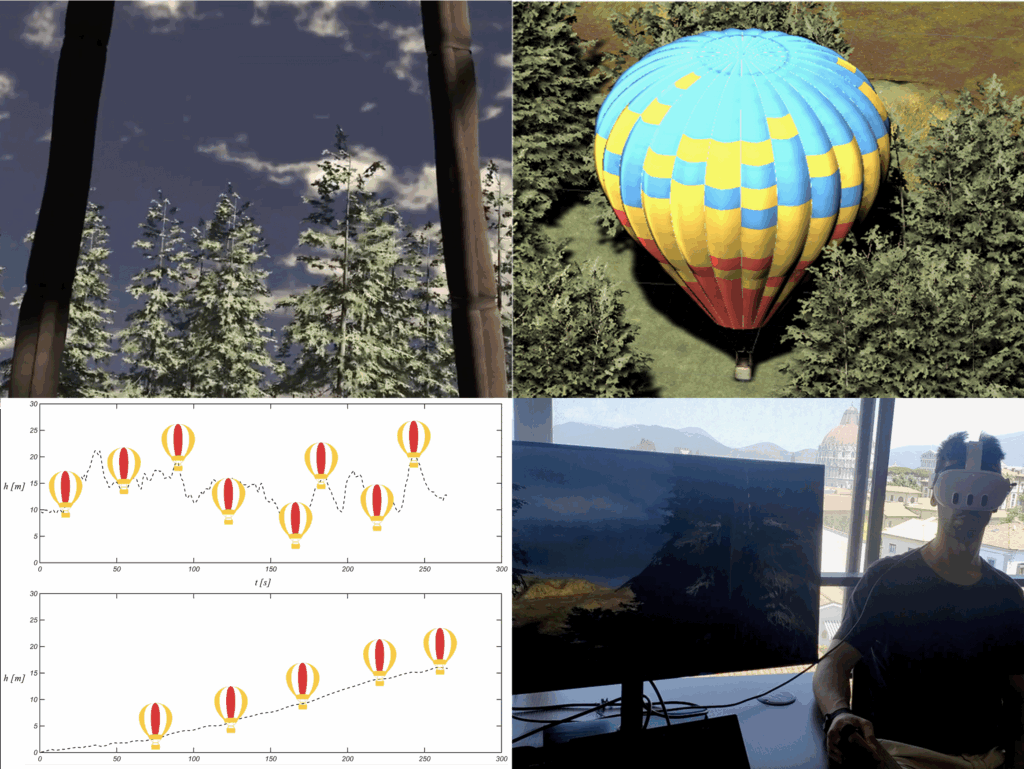
We develop biofeedback systems and virtual reality environments capable of adapting their behaviour according to the user’s estimated internal state. These systems are applied to scenarios such as social anxiety, phobias, therapeutic support, human–AI interaction, and social training.

By closing the loop between sensing, modelling, and actuation, we create environments that respond dynamically to the individual. This approach allows us not only to measure emotional processes, but also to influence and guide them through immersive, interactive technologies.

Here is our most representative paper about this research line
Link Link Read it online Newspaper Newspaper Download it!

Interpersonal Physiological Coupling

During social interaction, human physiological systems tend to align and influence each other in subtle but measurable ways.

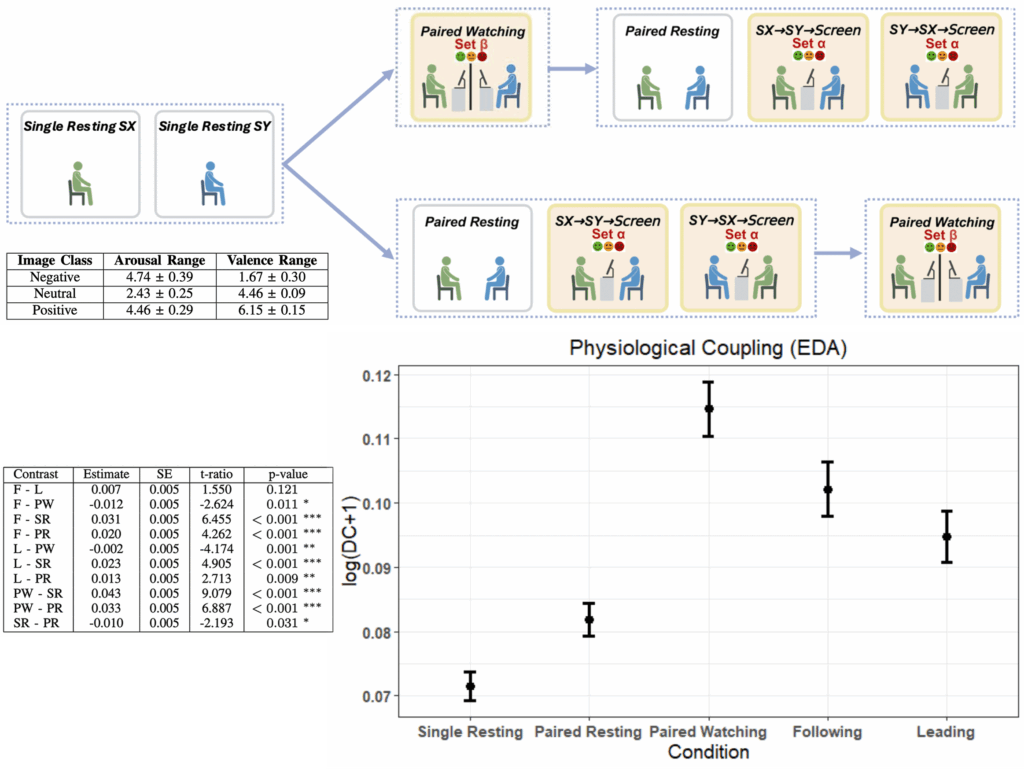
At BRAVE Lab, we study this phenomenon as interpersonal physiological coupling, a process through which people affect each other emotionally and biologically. Using hyperscanning approaches and multimodal sensing, we analyse synchrony, directionality, and temporal alignment across heart rate variability, electrodermal activity, respiration, and neural signals. This work supports the idea that social connection can be described as a dynamical coupling between physiological processes.

Our models aim to quantify emotional contagion, bonding, and social coordination, providing an objective framework to study how humans connect beyond observable behaviour.

Here is our most representative paper about this research line
Link Link Read it online Newspaper Newspaper Download it!

Real-World Gait Speed Estimation: An AI-Based Approach for Adaptive Wearable Devices Integration

M Zanoletti, C Vallati, N Carbonaro, A Greco, A Tognetti, M Laurino IEEE Access 14, 441-456, 2025

Real-world gait speed assessment, has recently gained recognition as an important health indicator particularly in patients with chronic conditions such as Chronic Obstructive Pulmonary Disease (COPD). This study proposes an AI-based method for estimating gait speed in the real-world context in COPD patients using different combinations of three wearable devices: a smartphone, a smartwatch, and...

2025

Analytical meditation improves physiological well-being in expert practitioners: a study on central and peripheral neurophysiological correlates

AL Callara, MH Azarabad, L Sebastiani, N Sherab, J Khechok, J Tsering, ... bioRxiv, 2025.12. 08.692357, 2025

Meditation has been long associated with improvements in mental well-being, emotional regulation, and attentional control. Yet, the diversity of meditative techniques and participant expertise has hindered the systematic identification of their neurophysiological correlates supporting these benefits. To address this challenge, we investigated the neurophysiological signatures of concentrative and analytical meditation in 35 experienced Tibetan monk...

2025

Dialectical behavior therapy in autistic adults: effects on ecological subjective and physiological measures of emotion dysregulation

ME Costache, F Gioia, N Vanello, A Greco, A Capobianco, S Weibel, ... Borderline Personality Disorder and Emotion Dysregulation 12 (1), 1-13, 2025

Although Ecological Momentary Assessment (EMA) and physiological measurements provide a valuable opportunity to evaluate therapeutic interventions in real time, no study has used this approach to assess Dialectical Behavior Therapy (DBT) in autistic adults with high levels of emotion dysregulation (ED). In this study, 26 autistic adults were evaluated before and after participating in a...

2025

EDArt: A Framework for the Simulation of Hand-Movement Artifact-Corrupted Electrodermal Activity Signal

G Rho, N Carbonaro, M Laurino, A Tognetti, A Greco 2025 IEEE International Conference on Metrology for eXtended Reality …, 2025

Electrodermal activity (EDA) is a key physiological marker of sympathetic nervous system activity, widely used in neuroscientific and clinical studies. However, motion artifacts, particularly those caused by hand movements, can introduce spurious conductance changes that resemble autonomic responses and compromise analysis reliability. While various artifact classification and denoising methods exist, they often require large labeled...

2025

FEV1 Trajectory Classification in COPD Patients

F Bossi, A Greco, G Rho, C Marinai, P Bufano, M Zanoletti, E Melissa, ... 2025 IEEE International Conference on Metrology for eXtended Reality …, 2025

Chronic Obstructive Pulmonary Disease (COPD) is a leading cause of morbidity and mortality worldwide, with progressive lung function decline severely affecting patients' quality of life. Spirometric assessment, particularly Forced Expiratory Volume in one second as a percentage of predicted (FEV1% predicted), is central to monitoring disease progression but is often impractical for regular use due...

2025
View All Publications

Mail Mail

We will reply as soon as possible

Contact us

Feel free to reach us for any need – whenever you want to (freely!) use the tools we developed, or you want us to share with you our data, or you want to interview us

© Copyright - BRAVE Project
Scroll to top Scroll to top Scroll to top